Day 1: Defining Clean Beauty
Video 1 of 3
This 10 day course will help you understand the beauty and cosmetics industry, and assist you in making better choices about the products that you choose to put in and on your body. In today’s lecture, we’ll be discussing what clean beauty means, and why it’s important to pay attention to the ingredients in your beauty products.
Marketing jargon is everywhere in the beauty industry, but what does clean beauty actually mean to us? Clean Beauty starts from within. The personal care products that we put on ourselves, and our loved ones matter. With more than 80,000 consumer chemicals in our everyday lives, it’s more important than ever to educate and empower ourselves about the choices we make for beauty.
Your free access to this course will expire in:
00
DAYS
00
HOURS
00
MINS
00
SECS
Video 2 of 3
What does Clean Beauty mean, and why does it matter?
- In this course, we’ll define Clean Beauty products as ones that are made from real, non-synthetic, ingredients, are non-toxic, and free from harmful effects.
- While most matter is technically a chemical, for this course we’ll use the world ‘chemical’ to refer to synthetic (lab-made) chemicals, and ‘botanical’ to refer to ingredients that are derived from plants.
- Synthetic chemicals are frequently used as a cheap preservative, often used to create shelf-stable products that maintain a consistent look, smell, and feel.
Synthetic chemicals to avoid in beauty products
- Avoid common chemicals like phthalates and parabens. They are frequently used as a cheap preservative, fragrance, or as a plasticizer for texture.
- Avoid sulfates, which are commonly used to create suds or foam, in addition to preserving a product.
- Lab-made synthetic chemicals are often used to bring the cost of producing a product down, since they are much cheaper to produce than plant-based botanicals.
- Synthetic fragrances do not have healing properties like the ones that are found in plant based botanicals.
Many synthetic chemicals have potentially harmful health effects
- There are over 80,000 synthetic chemicals in our everyday lives.
- Consumer chemicals are regulated by the Toxic Substances Control Act of 1976. At that time, over 60,000 chemicals that were already in use were grandfathered into the act, meaning that they were not reviewed for their safety, and are still considered ‘safe’ without further assessment.
- Many synthetic chemicals, especially those derived from petroleum, are potential endocrine disruptors.
- The endocrine system regulates hormone production, and many bodily functions like physical growth, mood, metabolism and system functions like sleep, energy and digestion, along with sexual and reproductive functions.
- Synthetic chemicals can mimic hormones in the body, and disrupt cell function.
- Check out our Top Ten Beauty Offenders list in the "Course Notes and Additional Resources" section below, and when in doubt–simplify.
Greenwashing is real
- Greenwashing is defined as when a company uses misleading claims about the environmental benefits of a product as a marketing ploy.
- Buzzwords like ‘natural’, ‘pure’, and ‘eco-friendly’ are not regulated by the FDA, and do not have a legal definition when it comes to cosmetics and beauty products.
- Many companies use buzzwords to lure customers into purchasing products that may not live up to their labeling.
Chemical regulation
- Congress has not updated cosmetics regulations since The Cosmetics Act of 1938, and the FDA does not test or approve beauty products before they are put on the market.
- Despite attempts at reigning in the cosmetics industry, no major new legislation has been able to pass in Congress since 1938.
- Over 1,200 chemicals that have been banned in Europe are allowed in U.S. cosmetics products. The U.S. has only banned about 10.
What to look for when buying beauty products
- Look for simply clean products, with a short list of ingredients that you know and can understand.
- Choose companies that prioritize ethical production of their products, and are invested in the actual product like smaller companies and local producers.
- Buy products that are created by companies with transparent practices.
- Upgrade your thinking and action around your beauty products.
Video 3 of 3
Day 1 Assignment
Take the opportunity to go through your makeup and beauty products, setting aside anything that has ingredients listed on our Top Ten Beauty Offenders list.
Daily Course Videos











This course is made possible by:

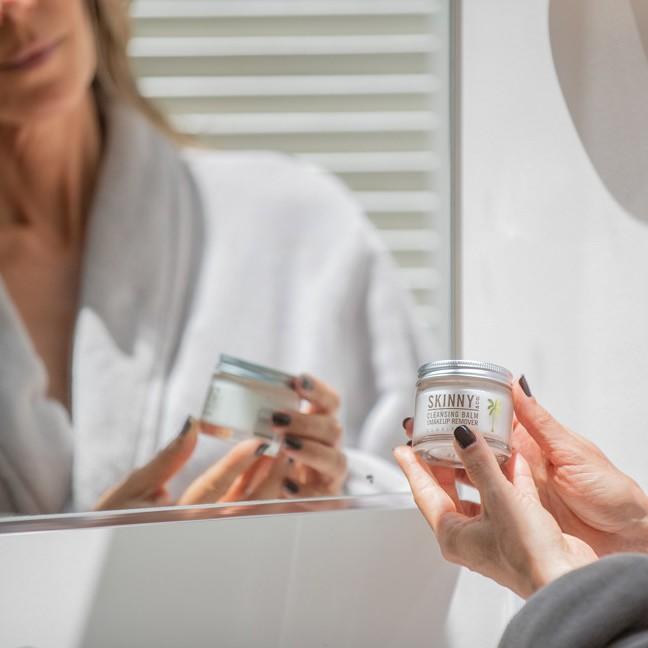
Marketing jargon surrounding our beauty products is often misleading. As Dr. Joy and Sophie told us today, simple is better. Skinny & Co.’s Cleansing Balm and Makeup Remover contains only pure ultra-cold pressed coconut oil and essential oils so you can be sure your products are clean and safe. Use code 30COMMUNE for 30% off Skinny & Co.’s range of products today!
Today’s Commun(ity) Question
Which products do you feel are impossible to give up? Why?
SHARE YOUR ANSWERCourse Notes and Additional Resources
Ingredients to avoid; based off of the Dirty Dozen list by the David Suzuki Foundation, with modifications to include ingredients that are banned in Canada or the EU, but still allowed in US cosmetics and personal care products.
1. BHA & BHT
Look for:
- butylated hydroxyanisole
- butylated hydroxytoluene
A common preservative found in food products, cosmetics, packaging, and plastics. Both stabilize fats, and prevent them from going rancid. BHA is considered reasonably likely to be a human carcinogen by the National Toxicology Program (U.S. Dept of Health and Human Services) and The International Agency for Research on Cancer. The EU classifies BHA as an endocrine disruptor. Both can induce allergic reactions in skin. BHT has potential to bioaccumulate, is toxic to aquatic organisms.
2. Coal Tar Dyes
Look for:
- p-phenylenediamine
- “FD&C” or “D&C” followed by a color name and number
Used commonly in cosmetics, Coal tar, a byproduct of coal production, is combined with a plethora of other chemicals (like tuluene, xylene, and benzene) to create artificial colours and dyes used in both cosmetics and hair dyes. Coal Tar Dyes may be contaminated with heavy metals. The EU considers p-phenylenediamine toxic when put on skin, inhaled or swallowed. It is also extremely toxic to aquatic organisms and. Warnings often include to keep hair dye products containing p-phenylenediamine away from eyes, as it “may cause blindness.”
3. DEA-related compounds
Look for:
- diethanolamine
- cocamide DEA
- lauramide DEA
- monoethanolamide
- triethanolamine
Used primarily in personal care products to make them creamy or sudsy. Found mostly in lotions, moisturizers, shampoos, soaps and other cleansers. The EU classifies DEA compounds as harmful, especially the potential serious damage that can be caused from prolonged exposure. These chemicals can react with nitrates to form carcinogenic nitrosamines.
4. Phthalates
Look for:
- diethyl phthalate (DEP)
- dibutyl phthalate (DBP)
- Other ingredients ending in ~phthalate
Often used as a plasticizer in a wide variety of personal care products including: nail polish, hair sprays, lotions, soaps, shampoos and fragrances. Phthalates have been linked to everything from asthma to neurodevelopmental issues and cancers. Exposure to phthalates in the US is omnipresent; nearly everyone tested for phthalate exposure had it present in their urine. Phthalates is a huge classification of chemicals, with some being ‘worse’ than others, but avoiding all phthalates is a good idea since many chemicals in the classification have yet to be studied. They are often not listed as an ingredient in many consumer products, but required to be listed in cosmetics and personal care products. Phthalates are common in plastics used in food packaging, and have been found in dairy products due to being extremely fat-soluble.
5. Formaldehyde & formaldehyde-releasing preservatives
Look for:
- DMDM hydantoin
- Imidazolidinyl urea
- Diazolidinyl urea
- Quaternium-15
- Bronopol (2-bromo-2-nitropropane-1,3-diol )
- 5-Bromo-5-nitro-1,3-dioxane
- Hydroxymethylglycinate
Mostly used as preservatives, these ingredients release a slow, small, and continuous stream of formaldehyde gas, and research suggests that formaldehyde can be absorbed through the skin. Formaldehyde use in cosmetics is not restricted by the FDA. While small amounts of formaldehyde are not considered extremely dangerous, consistent exposure, and especially inhalation, can be dangerous over time; formaldehyde is considered a known human carcinogen. Most commonly found in nail polish, nail polish remover, hair products, fragrances and some baby care products, along with baby wipes.
6. Parabens
Look for:
- methylparaben
- ethylparaben
- propylparaben
- butylparaben
- isobutylpraben
One of the most commonly used preservatives in cosmetics and personal care products, parabens are used most commonly to prevent the growth of bacteria and molds. Parabens are most common in makeup, moisturizers, hair products, shaving products and others. Parabens very easily penetrate human skin, and there is evidence that they interfere with hormone function, mimicking estrogen. When applied to the skin, parabens bypass the metabolic process and enter the blood stream and organs directly, and intact. Parabens have also been detected in breast cancer tissue.
7. Sulfates
Look for:
- sodium laureth sulfate (SLES)
- sodium lauryl sulfate
A very common ingredient in cosmetics, and personal care products like shampoos, shower gels, facial cleansers, and household products like dish soap. Sulfates are used to create suds, making a product foamy/bubbly. Sulfates are frequently contaminated with other human carcinogens like ethylene oxide. Sulfates can irritate the skin and eyes, and is toxic to aquatic organisms.
8. Fragrance
Look for:
- natural fragrance
- fragrance
- parfum
Fragrance is listed as a single ingredient despite being made up of a mixture of dozens of chemicals. There are around 3,000 chemicals used to create fragrances, and even ‘unscented’ or ‘fragrance-free’ products can contain may contain them, often along with a masking agent that prevents the brain from perceiving odor. Many of the unlisted chemicals in fragrances cause allergic reactions, and are not tested for their toxicity. Fragrance ingredients will often be used as a hidden preservative.
9. Triclosan
Most common in cosmetics, toothpaste, shaving cream, deodorant, cleansers, hand sanitizer, detergents and products advertised as “anti-bacterial.” Triclosan can pass through the skin, and may interfere with hormone function. The CDC detected triclosan in the urine of 75% of those tested, and studies have shown that it interferes with mitochondria (a cellular component) function. Triclosan is banned in the EU.
10. Siloxanes (aka silicones)
Look for:
- silicon-based compounds
- cyclotetrasiloxane (D4)
- cylcopentasiloxane (D5)
- dimethyl siloxanes and silicones
- dimethicones
Silicone-based compounds are used in moisturizers and facial treatments, along with hair products and deodorant creams to soften, smooth and moisten. Classified by the EU as endocrine disruptors, they may impair fertility and have caused uterine tumors in lab experiments. Silicones are toxic, persistent and have the potential to bioaccumulate in aquatic organisms.
Free access to this course will expire in:
00
DAYS
00
HOURS
00
MINS
00
SECS
By purchasing, you can unlock the rest of this course and start detoxing your entire self-care routine today.
In upcoming sessions you will learn how to clean up your self-care from the inside out.
Course participants get 50% off for a limited time!
Your purchase includes:

Permanent Access
Revisit Clean Beauty again and again as you need it — like a good reference book.

In-App Viewing
Watch videos offline, create custom playlists, and screencast to your TV.

More Ways to Learn
Access audio-only MP3 versions of the lectures.
We offer a 7-day money-back guarantee. So give it a try!